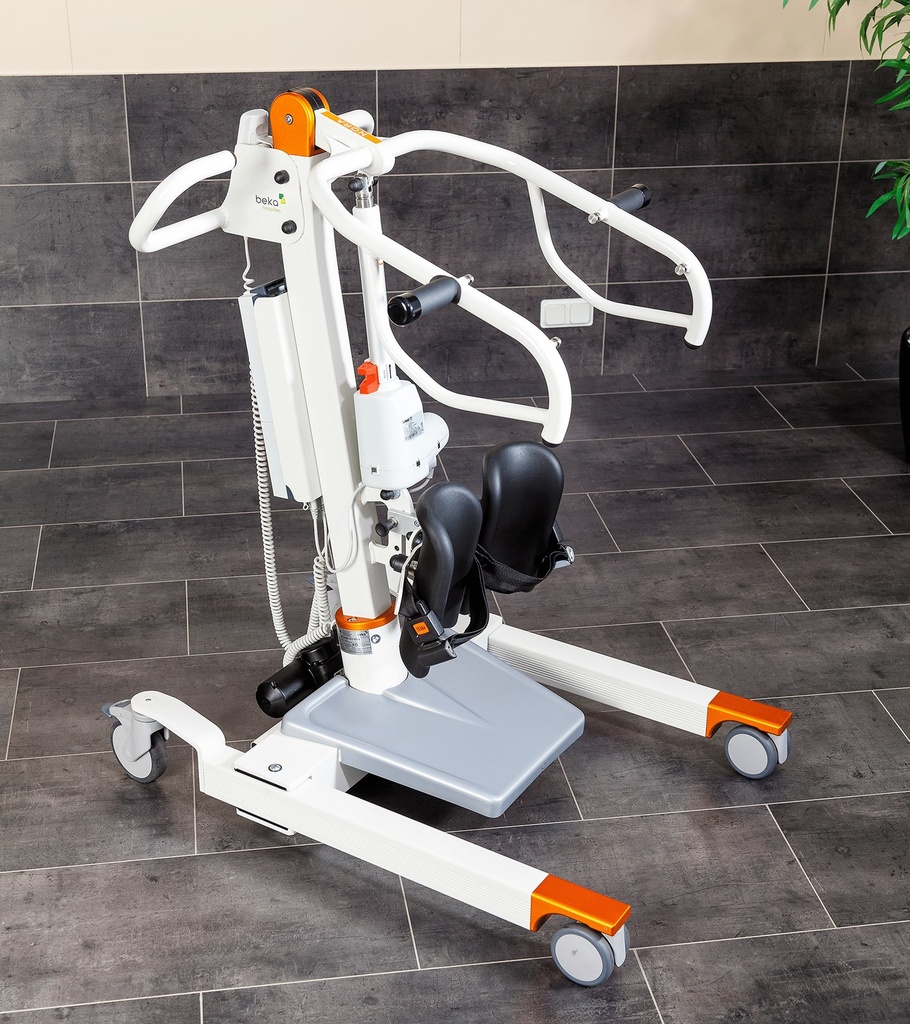
Description
The Beka Nora Leg Safety Belt is the belt that holds a person's lower leg against the knee pad while a NORA sit-to-stand lift raises them, manufacturer code K9200340. Beka's own service-parts description is "Leg safety belt with automatic lock", and the belt opens the way a car seatbelt does: press the buckle. Westin Healthcare stocks lift parts in Brampton and ships them across the Greater Toronto Area.
A NORA has two of these, one per leg. Beka's transfer procedure has the caregiver fasten both before the sling bow is raised, so a belt that will not latch, will not tension or will not release takes the lift out of service until it is replaced.
What the belt does during a stand
A NORA raises somebody from a footplate by rotating them forward and up. That only works if the lower legs stay against the knee pads through the whole movement. The knee pads are the fixed point; the leg safety belts are what stop the legs leaving them.
Beka's own description of the arrangement is worth reading in full, because it explains why the belts are adjustable rather than fixed:
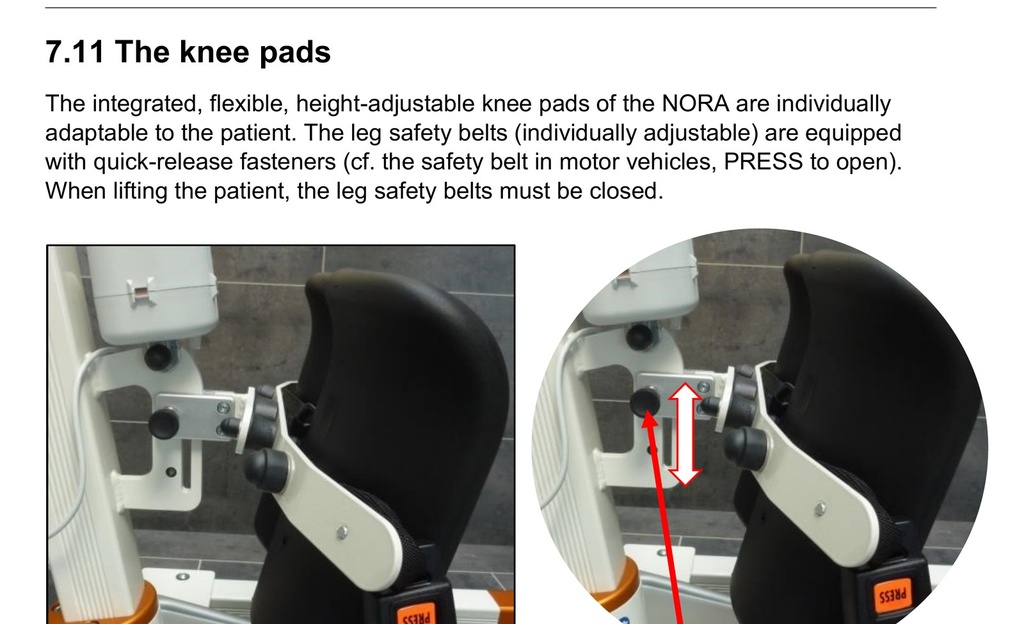
The integrated, flexible, height-adjustable knee pads of the NORA are individually adaptable to the patient. The leg safety belts (individually adjustable) are equipped with quick-release fasteners (cf. the safety belt in motor vehicles, PRESS to open). When lifting the patient, the leg safety belts must be closed.
Two things follow from that. The belts adjust to the person, so on a lift shared between residents they get set per transfer rather than once. And the release is deliberately a single press, because the moment you need a belt open in a hurry is the moment nobody should be working out a buckle.
Where it sits in the transfer
Beka's procedure for raising a patient from a bed or a wheelchair puts the belts at step 6, in a fixed order, and the order matters:
- Fit the sling around the back and fasten the belly part.
- Spread the carrier frame legs and lower the sling bow fully.
- Position the NORA so the legs rest on the knee pads at a right angle to the thighs, with the feet in the middle of the footplate.
- Lock the castors and engage the parking brakes.
- Tighten and fasten the two leg safety belts.
- Raise the sling bow and attach the sling to the attachment points.
- Raise the patient, keeping the leg safety belts closed throughout.
Note that the belts go on before the sling is attached and stay closed for the whole lift. They are not a finishing touch; they are what makes the geometry hold.
When to replace one
Beka's annual safety check includes a specific line item: check the function of the leg safety belts. In practice a belt gets replaced when any of the following shows up, and none of them is a reason to keep using it in the meantime:
- The buckle does not latch first time, or latches and then releases under load.
- The press-to-open release sticks, so a caregiver has to fight it.
- The webbing is frayed, cut, stiff or faded, or the adjustment slips under tension.
- The belt no longer tightens against the leg, so the leg drifts off the knee pad partway through a stand.
Beka prescribes an annual safety check on the NORA, carried out by adequately trained and qualified experts, with the check and any maintenance documented. A belt that fails that check is replaced, not adjusted.
Fitting it
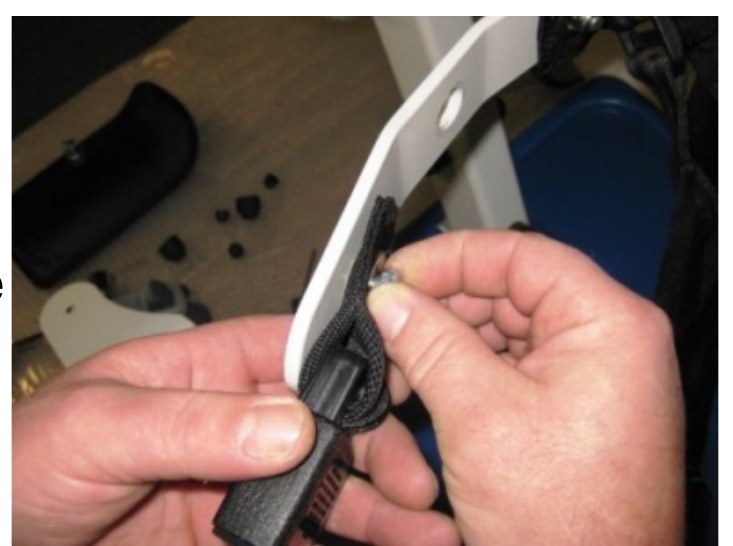
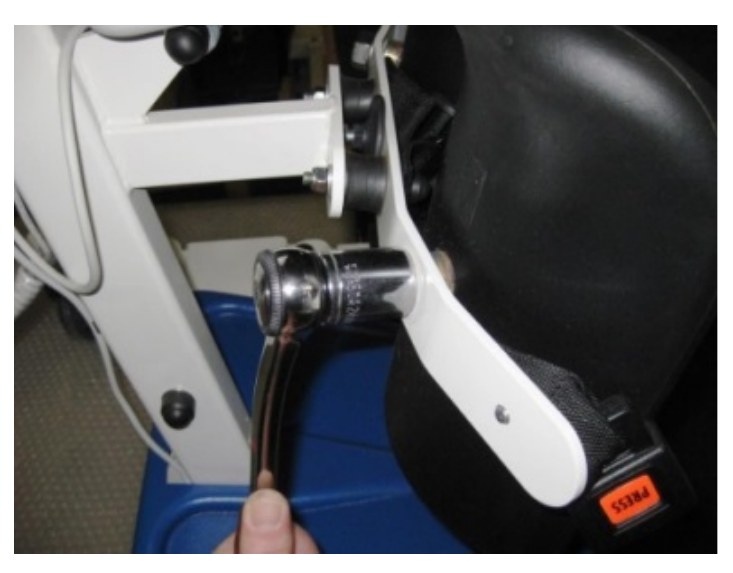
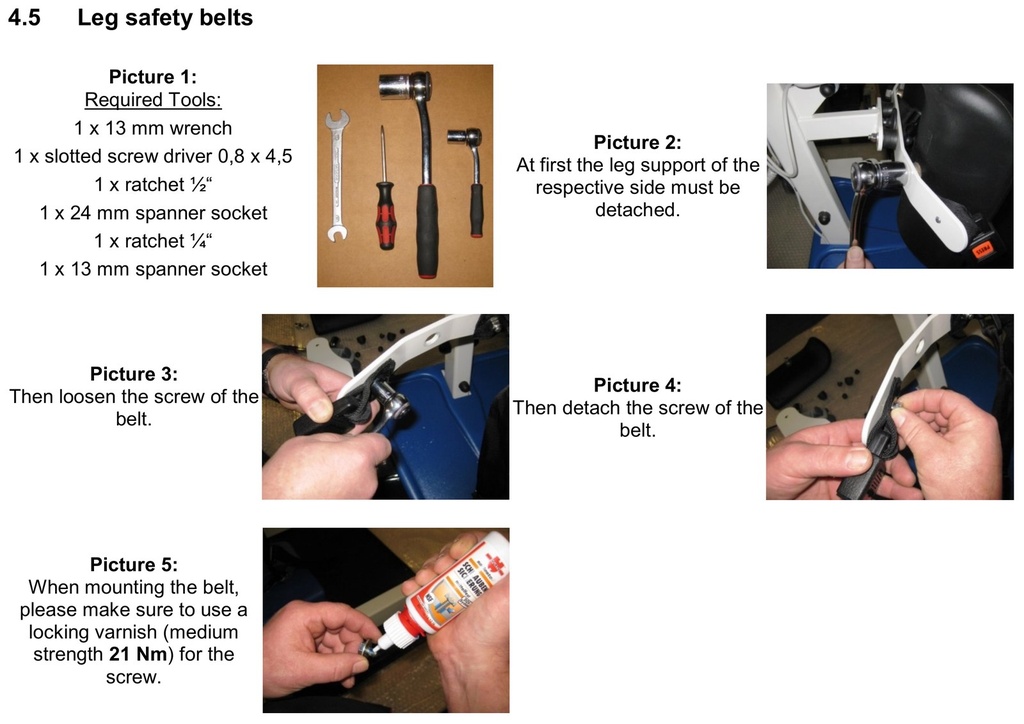
This is a technician job, and Beka's own service procedure shows why. The leg support on that side has to come off first, then the belt screw is loosened and removed, and the new belt is fitted with a medium-strength locking varnish on the screw torqued to 21 Nm. Assembly is the reverse. Beka's tool list for the job runs to a 13 mm wrench, a slotted screwdriver, a ratchet and 13 mm and 24 mm sockets.
The locking varnish is not optional. A belt anchor screw that backs out is a belt that lets go under load, which is the failure this part exists to prevent. Our technicians carry the right compound, fit the belt, and function-test the lift before we leave.
Beka Nora Leg Safety Belt specifications
| Specification | Leg safety belt (K9200340) |
|---|---|
| Brand | Beka Hospitec (Savaria Patient Care) |
| Product Type | Leg safety belt, sit-to-stand lift spare part |
| Manufacturer Code | K9200340 |
| Manufacturer Description | Leg safety belt with automatic lock |
| Fastener | Quick-release fastener, opened by pressing the buckle, as on a motor vehicle safety belt |
| Adjustment | Individually adjustable to the patient |
| Where It Fits | One belt per side, at the knee pad, on assembly position 30 of the NORA Alu |
| Belts Per Lift | Two, one for each leg |
| Documented Fitment | Beka NORA Alu sit-to-stand lifts (921071000, 921071008, 921071018) |
| Lift Safe Working Load | 200 kg (441 lb) on the NORA Alu |
| Fitted By | Authorized service personnel; the leg support is removed to reach the belt screw |
| Fitting Note | Beka specifies a medium-strength locking varnish at 21 Nm on the belt screw |
| Sold As | 1 belt, per the manufacturer's service-parts description. Confirm quantity when ordering |
Beka publishes no webbing length, width, material, colour or independent load rating for this code. The NORA documentation rates the machine and describes the belts in words. Nothing dimensional is printed here because nothing dimensional is published.
Quantity is worth settling before you order. Savaria's 2026 catalogue carries this one code twice, described once as "Nora Leg safety belts" and once as "Leg safety belt with automatic lock". The lift takes two, one per leg. Whether the code supplies one belt or a pair is not stated consistently, so this page prints the singular that Beka's own service-parts description uses and tells you to confirm the quantity when you call. A lift that comes back with one new belt and one perished one is a wasted visit.
Which lift this fits
Beka builds two generations of NORA and both use leg safety belts, but they do not share a spare-part numbering scheme.
| Lift | Manufacturer code | Does K9200340 apply? |
|---|---|---|
| NORA Alu, clip connection | 921071008 | Yes. K92003xx and K92004xx are the NORA Alu service-part range |
| NORA Alu, loop connection | 921074008 | Yes, same chassis and knee pads |
| NORA Alu, wall charger and two-battery builds | 921071000, 921071018 | Yes, same chassis and knee pads |
| NORA Pro, clip connection | 921078000 | Confirm before ordering. The NORA Pro has leg safety belts with a retractor mechanism and Beka lists its spares under 9210xxxxx codes |
| NORA Pro, loop connection | 921078001 | Confirm before ordering, as above |
Read the difference between the two generations, because it is a real one. On the NORA Alu the belts are individually adjustable with a car-style quick-release fastener. On the NORA Pro the leg straps run from a retractor: the caregiver pulls a strap from behind, clicks the connector into the buckle, and the retractor tightens the strap to the leg on its own, with a red button on the buckle to release it. Those are different mechanisms, so do not assume one belt serves both machines.
Call (905) 451-7743 with the code and serial number off your lift and we will confirm the belt with Savaria before anything ships. It does not fit a Handicare MiniLift, a Bure, a QuickMove or a Span America F500S, none of which use this arrangement.
Related NORA parts and machines
- The Beka Nora Carry Bar Loop Pin Kit, the other NORA soft-fitting part we stock.
- The Beka Nora Pro Lithium Ion Battery Pack, code 921077400, for the NORA Pro.
- The knee upholstery itself is a separate Beka part, K9200330, supplied left and right complete. If the belts are worn, the pads behind them usually are too, and it is worth quoting the pair together. Call us and we will price both.
The complete machines are on the sit to stand lifts hub: the NORA Alu in clip and loop builds, and the NORA Pro in both. The rest of our spares sit on the lift parts shelf and everything else is on the patient lifts hub.
Slings for a NORA are quoted separately and sized to the person. Beka is firm that clip slings and loop slings are not interchangeable between the two carry-bar types, so tell us which build you have when you ask.
Delivery and setup in Brampton and the GTA
Small parts ship on our standard service. Westin's own team delivers across Brampton and the Greater Toronto Area, and you are welcome to visit our Brampton showroom, or Mobility Specialties, our partner store in Etobicoke, if you would rather match the part to your lift in person.
Call (905) 451-7743 with the model and serial number off your lift and we will confirm the fit before the order goes out. Shipping terms are on the shipping policy page, and any charge is confirmed on your order.
Service, repairs, and warranty
When something on the lift needs work, you call the shop that set it up, not an overseas parts desk. Westin Healthcare has a service and repairs department, and our technicians come to the home or workplace.
Beka warranty and the annual safety check
Beka publishes no standalone warranty document for NORA parts. The liability and warranty section of the NORA operating manual is the only warranty text Beka prints and it carries no year count, so ask us for the current terms that ship against your order and we will handle a claim with you.
Two Beka rules bear directly on this part. The operating manual states that the product should be operated only with original accessories, and that Beka accepts no liability for damage resulting from the use of spare parts or accessories that are not original. And Beka prescribes an annual safety check, carried out only by adequately trained and qualified experts, documented and available on request, with the function of the leg safety belts named as one of the items checked. We can quote the annual inspection with the part.
Frequently asked questions
What is the leg safety belt for?
It holds the lower leg against the knee pad while the NORA raises the person. Without it the leg can drift off the pad partway through the stand, which is the moment the transfer stops working. Beka's instruction is that the belts must be closed while the patient is being lifted.
How many does a lift take?
Two, one for each leg. Beka's transfer procedure says to tighten and fasten both before raising the sling bow.
Does this code supply one belt or a pair?
Beka's service-parts description is singular, "Leg safety belt with automatic lock", while the catalogue row is plural. Because the lift takes two, this is worth settling before you order rather than after. Call (905) 451-7743 and we will confirm the quantity with Savaria and quote the pair if that is what you need.
Will it fit my NORA?
It is a NORA Alu part: the K92003xx and K92004xx range is the NORA Alu service-part numbering. If you have a NORA Pro, whose leg straps run from a retractor rather than a car-style buckle, call us and we will confirm the right part with Savaria first. It does not fit a MiniLift, a Bure, a QuickMove or a Span America F500S.
How does the buckle work?
Like a car seatbelt. Beka's own comparison, in the manual: quick-release fasteners, press to open. The belt latches automatically when the tongue goes in, and one press releases it.
Can I fit it myself?
No, and it is not a hard rule to justify. The leg support has to come off to reach the belt screw, and Beka specifies a medium-strength locking varnish at 21 Nm on that screw. A belt anchor that backs out is a belt that lets go under load. Our technicians carry the compound, fit the belt and function-test the lift.
When should a belt be replaced?
When the buckle does not latch first time or releases under load, when the release sticks, when the webbing is frayed, cut, stiff or faded, or when the adjustment slips so the belt will not hold tension. Beka's annual safety check includes checking the function of the leg safety belts, and a belt that fails it gets replaced rather than adjusted.
Should I replace the knee upholstery at the same time?
Often, yes. Beka lists the knee upholstery as its own part, K9200330, supplied left and right complete. Belts and pads wear on the same schedule because they take the same loads from the same people. Ask us to quote both and decide once you have seen the numbers.
Can I use a belt from another manufacturer?
No. Beka's manual is explicit that the product should be operated only with original accessories, and that it accepts no liability for damage resulting from spare parts or accessories that are not original. On a part that holds somebody's leg in place during a lift, that is not a formality.
Specifications
| Product Type | Leg safety belt, sit-to-stand lift spare part |
|---|---|
| Sold as | 1 belt, per the manufacturer's service-parts description. Confirm quantity when ordering |
| Manufacturer Code | K9200340 |
| Adjustment | Individually adjustable to the patient |
| Manufacturer Description | Leg safety belt with automatic lock |
| Lift Safe Working Load | 200 kg (441 lb) on the NORA Alu |
| Documented Fitment | Beka NORA Alu sit-to-stand lifts (921071000, 921071008, 921071018) |
| Fitted By | Authorized service personnel; the leg support is removed to reach the belt screw |
| Fastener | Quick-release fastener, opened by pressing the buckle, as on a motor vehicle safety belt |
| Where It Fits | One belt per side, at the knee pad, on assembly position 30 of the NORA Alu |
| Belts Per Lift | Two, one for each leg |
| Fitting Note | Beka specifies a medium-strength locking varnish at 21 Nm on the belt screw |
Documents
- Brochure NORA Sit-to-Stand Lift Brochure, Handicare by Beka
- Brochure NORA Sit-to-Stand Lift Quick Start Guide, Handicare by Beka
- User Manual Owner's Manual, Beka NORA Alu Sit to Stand, V2.13 E
- Parts Manual Service Manual, BEKA Nora ALU Stand Aid, V1.5 EN
- All Forms and Documents Every form, brochure and document in one place.
Shipping and Delivery
We deliver and set up equipment across Brampton and the Greater Toronto Area. Our team brings the equipment in, sets it up and shows you how to use it.
Planning a rental? Rental equipment is delivered and picked up by our team within the same service area. Learn about rentals.
To schedule a delivery or ask about timing, call us at (905) 451-7743.
Replacement parts for this model
Questions about this product?
Talk to a local specialist today. We will help you find the right equipment and the funding to cover it.