Handicare Freecurve
curved stairlift
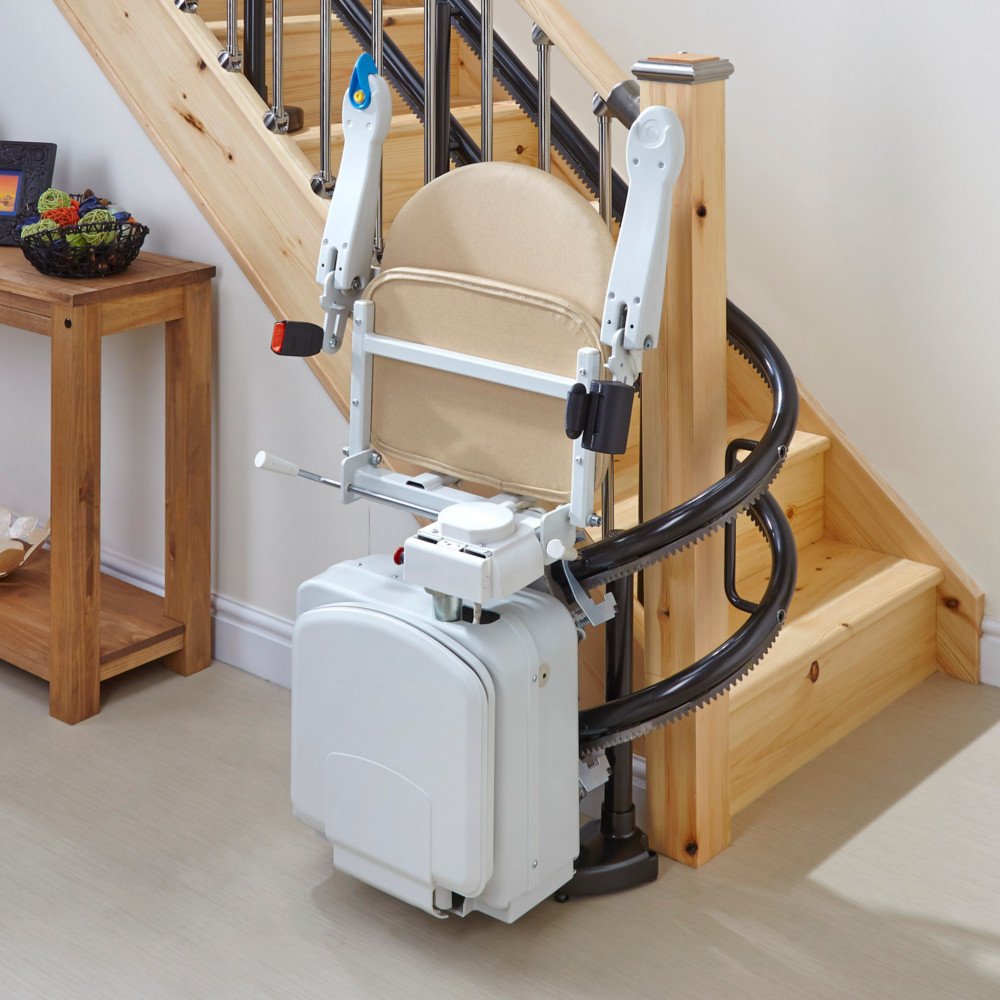
A single tube rail, measured and fabricated for your staircase alone. Turns, winders, spirals and landings are drawn into the rail rather than worked around.
Before it is built, you see a 3D render of the finished lift standing on your own stairs. Installed across Brampton, Mississauga, Toronto and the GTA by our own technicians.
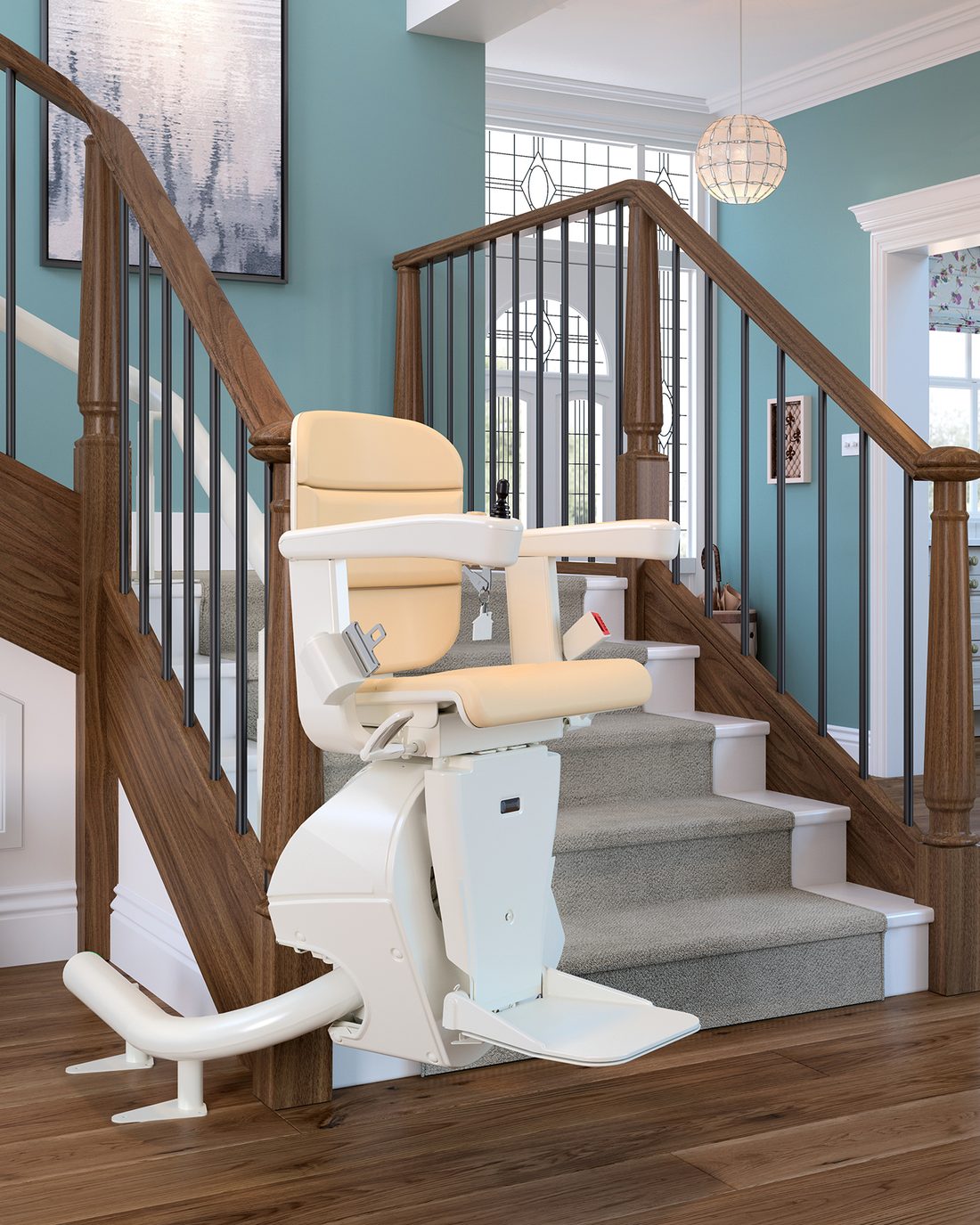
You approve a 3D picture of it on your stairs. Then it gets built.
A curved rail is a one-off object. It cannot be returned to a warehouse and it cannot be swapped for a different shape, which is why guessing at the outcome is the wrong way to buy one.
Handicare's PS4D system photo-measures your staircase during the free assessment. Their engineers turn that survey into a computer-aided drawing, and you get a 3D visualisation of the finished lift on your own treads, walls and balustrade before the order goes to the factory.
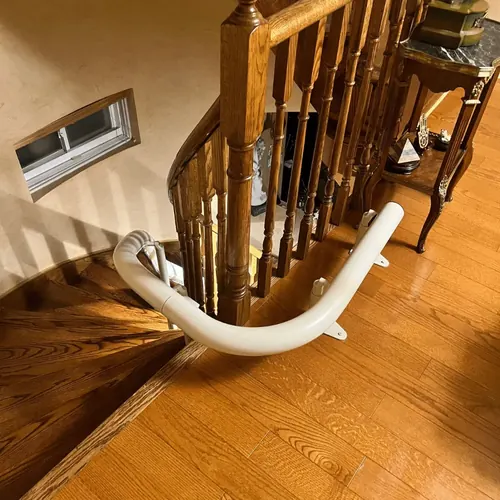
A single rail, and fewer legs holding it up.
Most curved stairlifts run on a twin rail carried by a row of floor stanchions. The Freecurve uses one tube, and Handicare builds the standard capacity model with fewer floor stanchions than other curved stairlifts.
On a staircase that is already tight, that is the difference between a rail you notice and a rail you walk past. The chair folds back to 16.5 to 17.4 inches when nobody is riding it, and Handicare designs the rail to follow the curves and turns of your stairs as tightly as possible, leaving room on the stairs for others.
It fixes to the stairs, not the wall
The rail mounts to the stair treads, so no wall needs opening and no structural work is involved. Handicare is explicit that no further modification to the home is required.
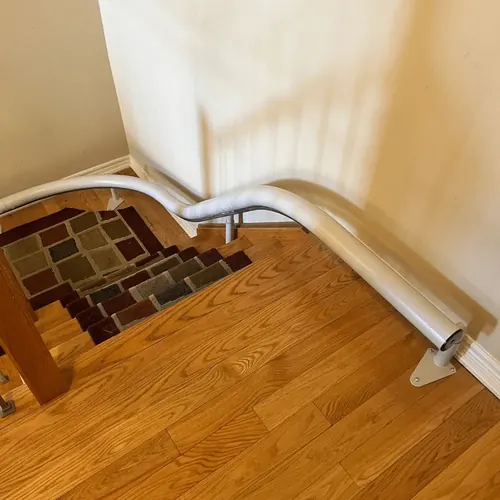
If your stairs do anything other than run straight, this is the model.
A straight rail is cut from stock. A curved rail is drawn. Because the Freecurve rail is fabricated to your photo survey, the shape of the staircase becomes an input rather than an obstacle, and the six situations below are all ordinary work.
90° turns
The most common curved staircase in the GTA. The rail follows the turn in one continuous piece rather than stopping and restarting.
180° switchbacks
Stairs that double back on a half landing. One rail carries you the whole way, so there is no transfer between two lifts halfway up.
Winders and pie-shaped treads
Where the treads narrow to a point at the turn. Handicare names pie-shaped stairs specifically as a Freecurve application.
Spiral staircases
A continuous curve is no harder for a custom rail than a single turn, because the rail is drawn to the curve either way.
Narrow stairwells
Handicare states that even narrow or steep staircases can usually be accommodated, thanks to the two-way power swivel that turns the chair as it travels.
Steep stairs, and flat runs
Anywhere from 0° to 61°, so the same rail can cross a flat landing and then climb a steep older staircase.
Either side of the stairs
The rail can be drawn to the left or the right wall, whichever keeps your doorway, radiator or window clear. We decide which side at the survey, before anything is made.
Past the top step
The rail can carry on beyond the last tread so you step off onto level floor at the landing, rather than getting up while still over the staircase.
The incline range runs 0° to 61°, and the 0° end matters more than it sounds: it is what lets one rail cross a flat landing and then climb a steep older staircase.
Have us measure itA door at the bottom of the stairs is not a dealbreaker.
This is the part nobody thinks about until the survey, and it is the part that decides whether the finished lift feels tidy or feels in the way. The rail has to run past the last step, and that often puts it across a doorway. Four answers, all photographed on staircases we have fitted.
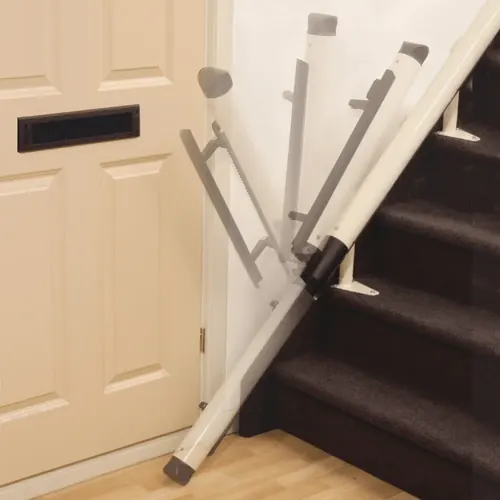
To take away the tripping hazard of a rail ending at the bottom landing, a powered folding hinge lifts that section up and out of the way. The rail is only there while you are riding.
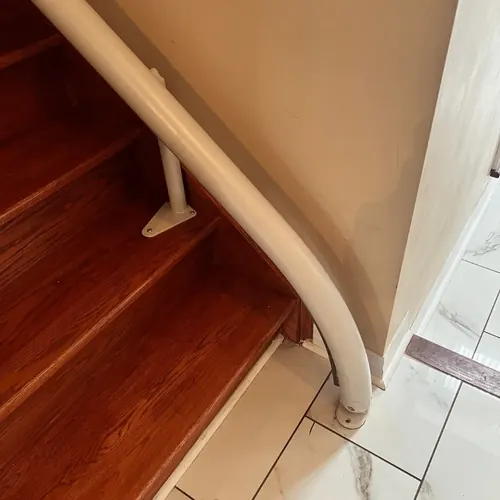
A simpler answer to the same problem. The rail end curls down to floor level, which keeps it low and out of the walking line at the bottom step without any moving parts.
Parking keeps the chair away from the foot of the stairs, giving you room to get on and off and leaving the staircase clear. Handicare offers parking as a 90° or a 180° turn.
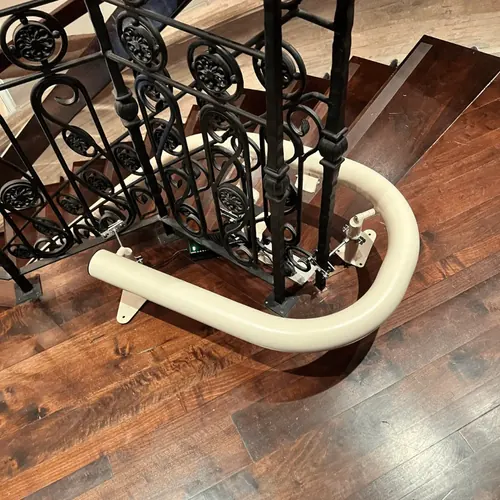
The other parking configuration. The rail loops right around so the chair faces back out into the hallway, which is the easiest of all to get on and off.
Not sure which one your staircase needs? That is exactly what the free visit is for.
Book a free measure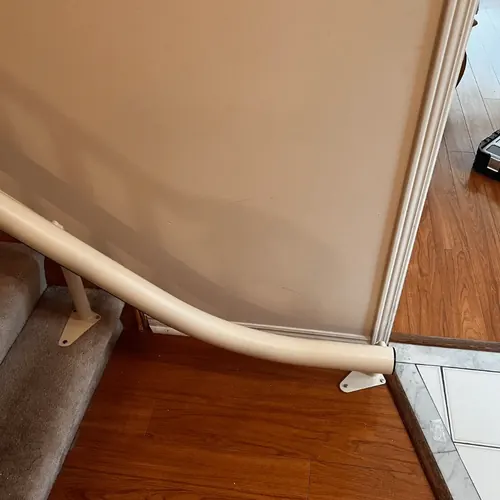
It charges wherever it stops, and locks when you want it to.
Built-in charging stations keep the lift charged and ready, so it is not something you have to remember to plug in. It runs on batteries, so a power cut is not the end of it: Handicare states you can use the lift several times during a power outage.
Two remote controls come as standard, so the chair can be called up or down the stairs to whoever needs it rather than left wherever it was last parked.
A keyed switch, standard on every Freecurve
Turn the key and the lift will not run. It is the answer to the question every grandparent asks us, and it comes fitted rather than as an extra.
Getting on, and getting off again
The seat parks at the bottom of the stairs, turned to face you, so sitting down is a step across rather than a reach backwards. A manual swivel lever is standard and it is enough for most people.
The four options below exist for the specific movements that hurt. Tell us which one that is at the assessment and we will price only that.
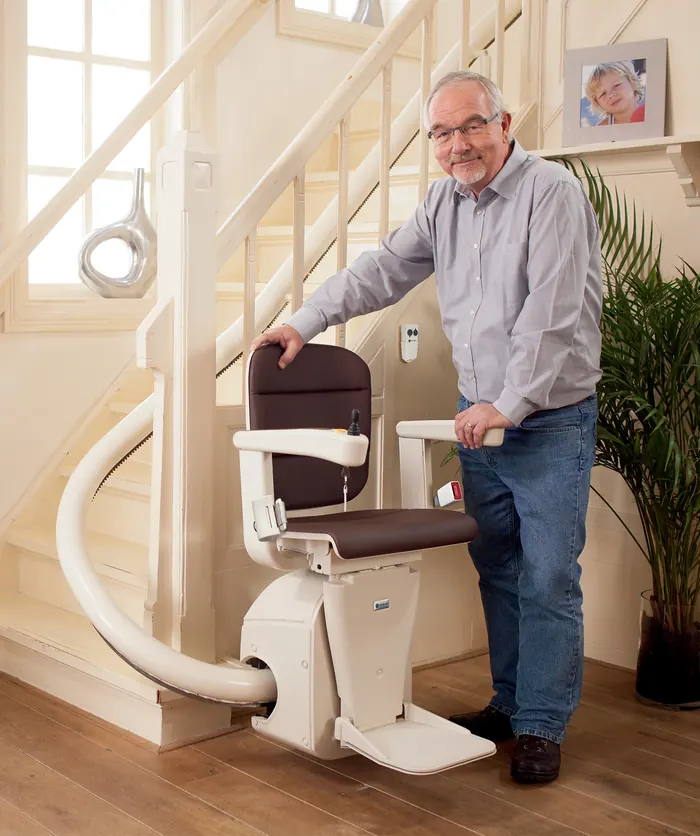
Powered swivel
Hold the toggle towards the landing and the seat turns through 80 degrees, so you stand up facing the floor rather than the stairs behind you. A manual swivel lever is standard.
Two-way power swivel
The chair turns itself on an angle as it moves up and down, giving the lift the clearance it needs to pass. Handicare offers this specifically so narrow staircases can still be accommodated.
Active Seat
A lever gently supports you as you sit down and as you rise, taking the strain off knees and hips. Available on the Alliance and Elegance seats only.
Powered footrest
Folds and unfolds without anyone bending to floor level, and includes LED illumination, which is genuinely useful on a dark staircase at night.
Three seats, and one of them rules out two options
Classic, Alliance and Elegance. The important thing to know before you fall in love with one: the Active Seat and the body harness are available on the Alliance and Elegance only. If you need either, the Classic is out.
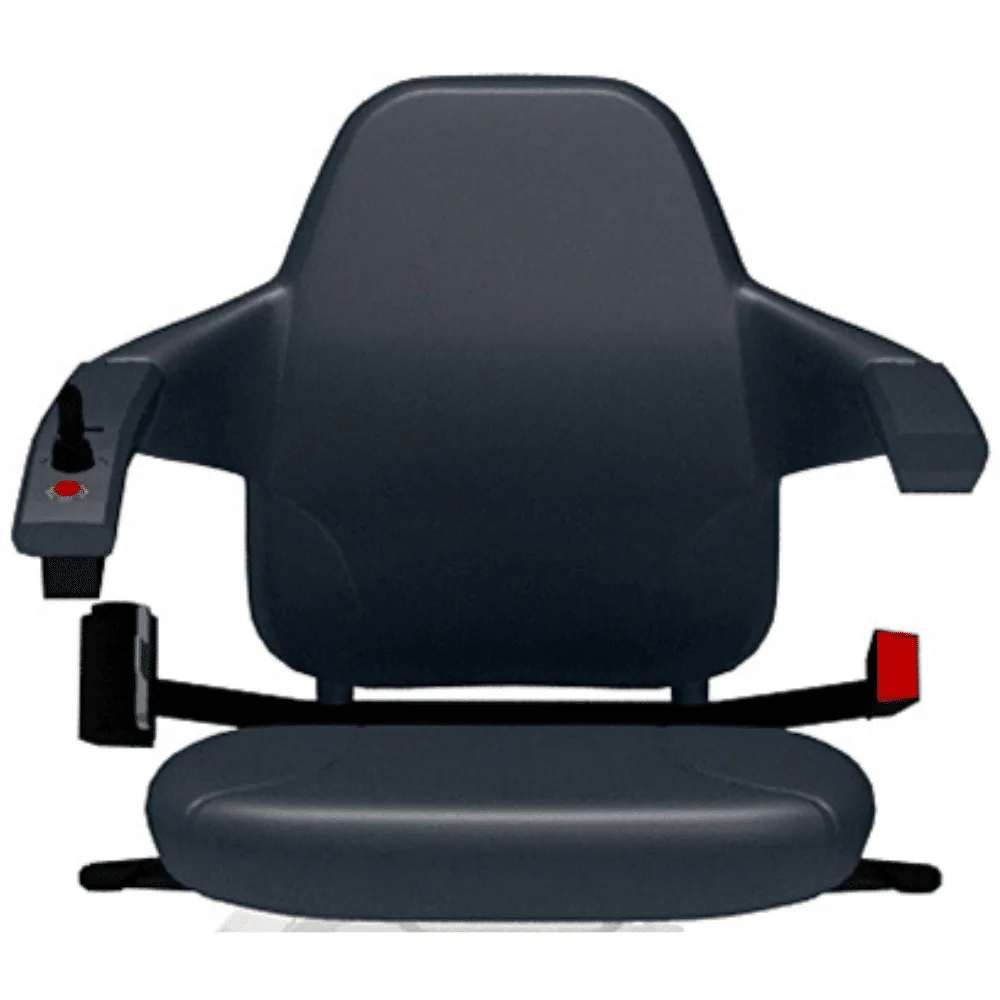
Developed with input from therapists, in a leatherette-grain finish. An ergonomic seat that does not draw attention to itself, and the most straightforward of the three.
Seat colours: Beige, Brown, Slate
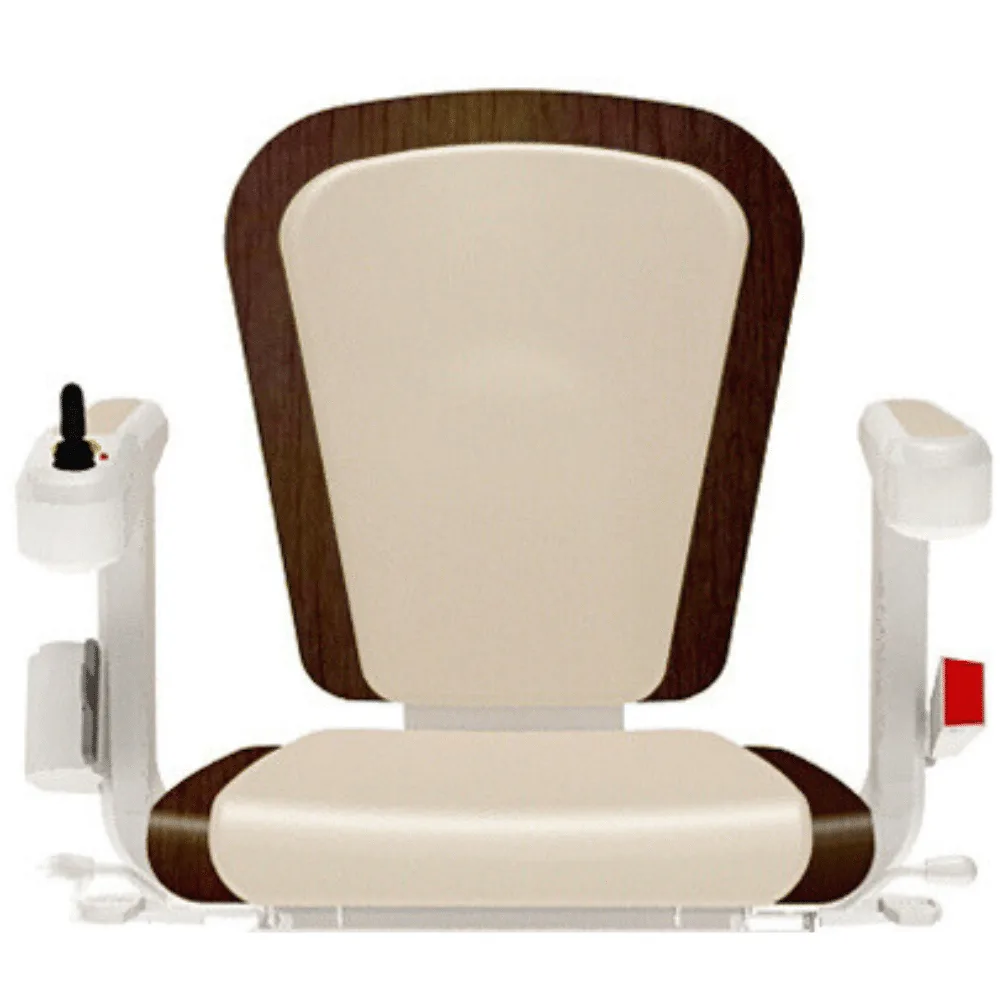
Two-tone beige and brown leatherette, which Handicare describes as a slim and smart look. The least bulky of the three on a staircase you can see from the front door.
Seat colours: Beige, Brown, Slate
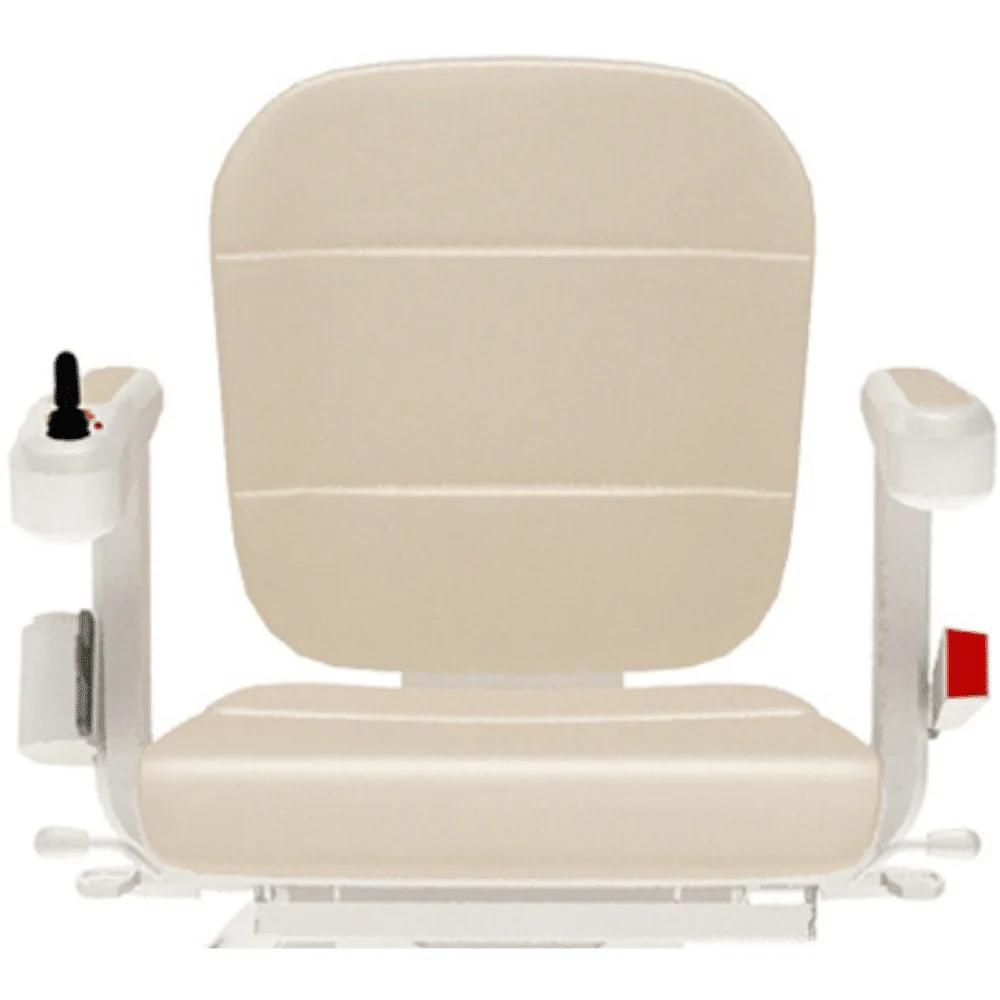
Extra-soft leatherette, with armrests that adjust outwards to widen the seat. If comfort over a long staircase is the priority, this is the one we usually suggest sitting in first.
Seat colours: Beige, Brown, Slate
Seats and colours, side by side
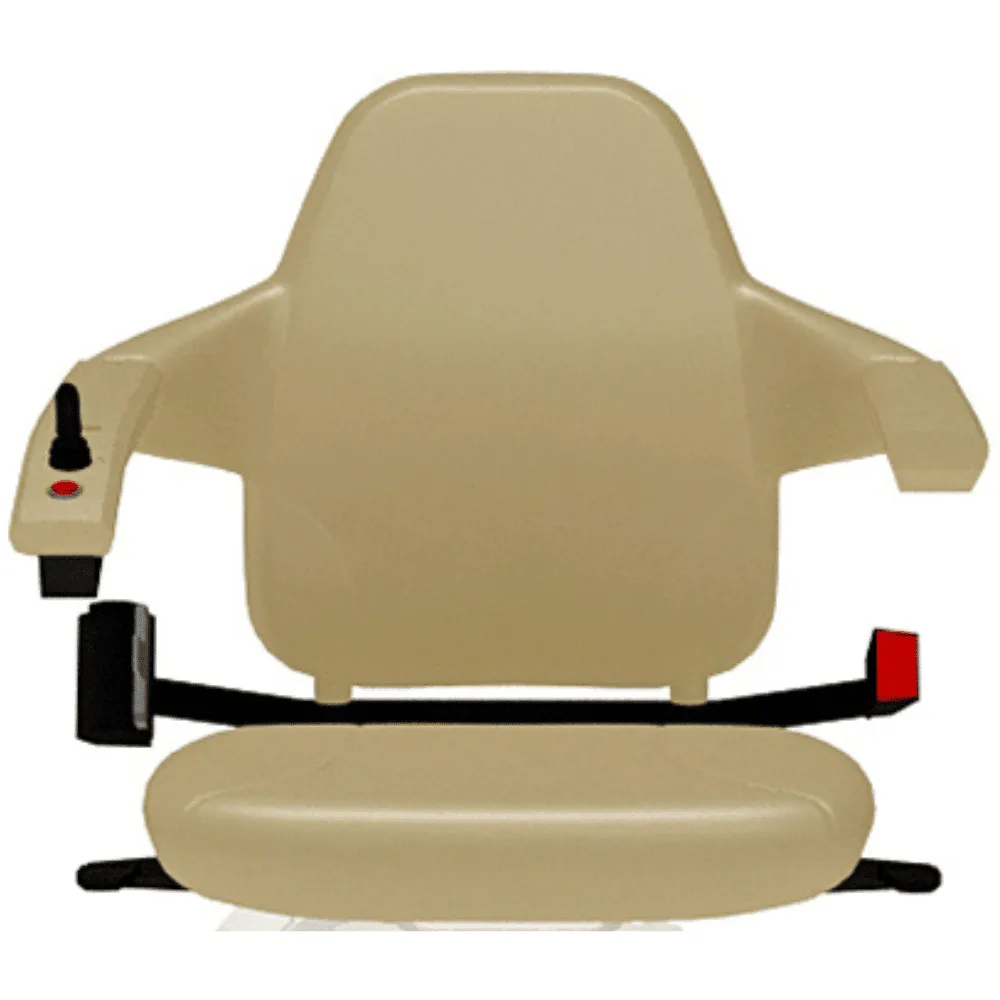
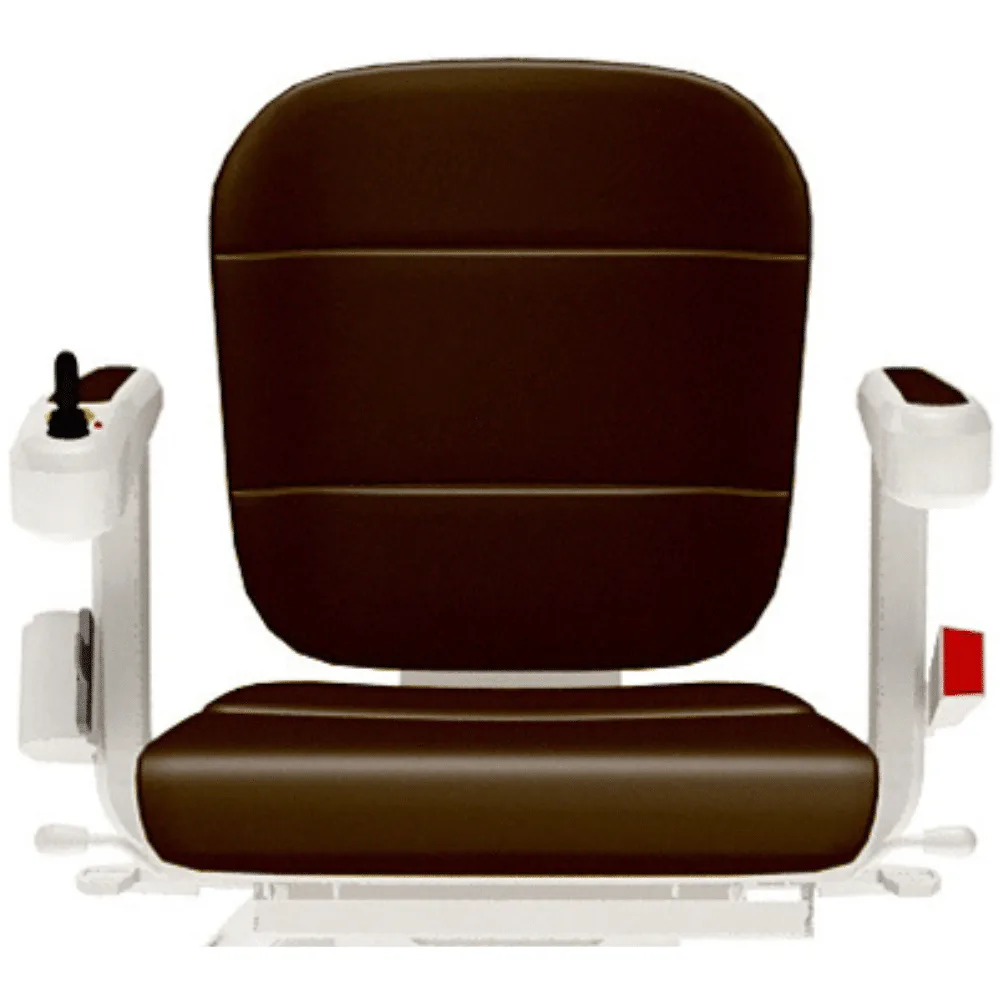
Three standard colours, and the rail is the part you see.
The chair folds away. The rail does not, so it is worth a minute of thought. Cream White disappears against pale walls and light trim; Grey reads as hardware and suits contemporary interiors; Brown sits closest to stained wood balustrades.
Custom colours are available at an additional charge. If you want the rail matched to a specific trim, raise it at the assessment rather than after the survey goes to the factory.
Swatches are a guide only. Screens vary, and so does the light on your staircase. Ask to see the physical samples at the visit.

Disappears against pale walls

Closest to stained wood

Reads as hardware
The three seats, measured against each other.
Alliance and Elegance are dimensionally identical apart from how far the seat back sits off the wall, where the Elegance needs a little more room for its thicker upholstery. The Classic is the shallowest seat and sits marginally lower.
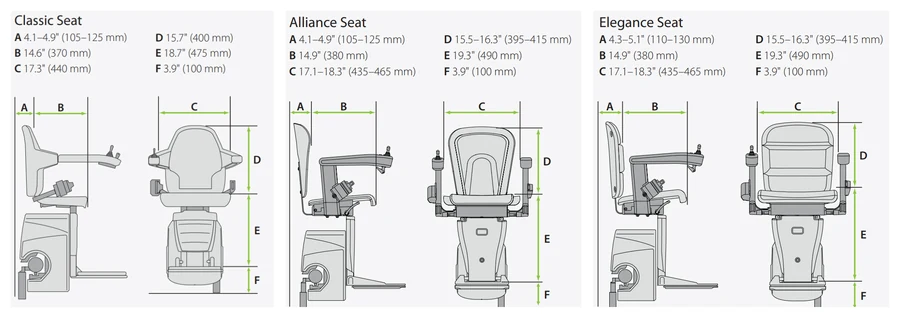
| Dimension | Classic | Alliance | Elegance |
|---|---|---|---|
| Wall to inner seat back | 4.1-4.9 in | 4.1-4.9 in | 4.3-5.1 in |
| Seat depth | 14.6 in | 14.9 in | 14.9 in |
| Armrest width, internal | 17.3 in | 17.1-18.3 in | 17.1-18.3 in |
| Seat back height | 15.7 in | 15.5-16.3 in | 15.5-16.3 in |
| Footrest to seat height | 18.7 in | 19.3 in | 19.3 in |
| Footrest height, minimum | 3.9 in | 3.9 in | 3.9 in |
Figures as published by Handicare. Please note that all dimensions can vary slightly due to specific site installations and adjustments, so treat them as planning figures and let us measure before you commit.
Full specification
As published by Handicare. See dealer for complete warranty details. Anything not listed here we confirm in writing with your quote rather than guess at.
Standard, not extra
Everything in this list comes on every Freecurve, including the keyed switch that locks the lift out when grandchildren visit.
- Retractable seat belt
- Emergency stop button
- Obstruction sensors on the footrest and the carriage
- Non-slip footrest material
- Battery power during an outage
- Two remote controls, to call the lift up or down
- Joystick control built into the armrest
- Manual swivel lever
- Keyed switch to prevent unauthorized use
Where the Freecurve is not the answer
- A straight staircase, where a straight rail costs less and installs the same day
- Anyone needing more than 275 lb of capacity
- Outdoor steps, since the Freecurve is rated for indoor residential use only
Freecurve rails we have fitted
Every one of these rails is a different shape, because every one of these staircases is. Photographs from our own installations across the GTA.
Why we will not put a price on this page
A curved rail is manufactured to your staircase, so there is no list price to quote. The number of turns, the total length, the seat you choose and the landing solution all move it, and any figure printed here would be wrong for most houses.
What we can promise is that the assessment and the written quote are free, and that the figure we give you is the figure you pay.
Get a written priceFunding for a curved stairlift
Stairlifts are not covered by Ontario's Assistive Devices Program. March of Dimes HVMP may fund an eligible stairlift when applicant, request and authorization rules fit. WSIB may help only on an allowed work-related claim with clinical support and authorization. Veterans Affairs POC 13 may help only for an eligible assessed need with benefit-grid approval. IFHP may cover eligible benefit-grid equipment. The federal Home Accessibility Tax Credit may offset part of an eligible enduring home renovation when CRA eligibility rules fit. ODSP Mandatory Special Necessities excludes home renovations such as ramps and stairlifts.
Westin prepares quotes and documents; billing follows the program, claim or plan authorization. We will tell you honestly at the assessment which of these you may be able to apply for.
See the funding programs we work with →Questions we get asked about curved stairlifts
If yours is not here, call us on 905 451-7743. A person answers during business hours.
Can a stairlift be fitted to a curved or spiral staircase?
Yes. The Freecurve rail is custom fabricated to the exact shape of your staircase, so turns, curves, winders, pie-shaped treads, spirals and intermediate landings are all workable. We photo-measure your stairs at the free assessment and the rail is then built to that survey in North America.
Can I see what it will look like on my stairs before I order?
Yes, and we recommend it. Handicare's PS4D photo-measuring system produces a 3D visualisation of the Freecurve on your own staircase before the order is placed, so you can judge the rail line, the parking position and the colour against your own treads and walls.
How much does a curved stairlift cost in Ontario?
It is priced per staircase, because the rail is manufactured to your survey. The number of turns, the length, the seat and the landing solution all change the figure, which is why no honest list price exists for a curved lift. We give you a written price at the free in-home assessment with no obligation.
How long does a Freecurve take to install?
Handicare states that installation takes from a few hours to a full day, depending on how complex the rail is. The rail itself is fabricated after the survey, so allow manufacturing time before the installation date. We confirm the schedule in writing with your quote.
Will installing it damage my staircase or need renovation?
No. The Freecurve fixes to the stair treads rather than to the wall, so there is no structural work and no wall opening. Handicare is explicit that because it is fixed to the staircase, no further modification to the home is needed.
Will there still be room for everyone else to use the stairs?
Yes. Seat, arms and footrest all fold, leaving 16.5 to 17.4 inches of depth, and Handicare builds the rail to follow your stairs as tightly as possible so there is room left for others. The standard capacity Freecurve also uses fewer floor stanchions than other curved stairlifts, which is what keeps the floor at the bottom clear.
What if the rail would block a door at the bottom of the stairs?
Two options solve it. A powered folding hinge lifts the end of the rail up and out of the doorway. A drop nose curls the rail end down to floor level for a lower, less obtrusive finish. We check the doorway at the assessment and recommend one. Parking the chair at the bottom landing, in a 90 or 180 degree turn, is a third way to keep the area clear.
My staircase is narrow. Is that a problem?
Usually not. The two-way power swivel automatically turns the chair on an angle as it travels up and down, which gives the lift the clearance it needs to pass. Handicare states that even narrow or steep staircases can usually be accommodated this way, and the single tube rail helps as well.
Which seat should I choose?
Sit in all three if you can. The Classic is therapist-designed and the most straightforward, the Alliance looks the most like furniture, and the Elegance has the softest upholstery. One practical constraint decides it for some people: the Active Seat and the body harness are not available on the Classic.
What is the weight limit?
275 lb (125 kg). If you need more than that, say so at the assessment and we will look at what else suits your staircase rather than sell you a lift that is at its limit.
Does it work in a power outage?
Yes. Built-in charging stations keep the lift charged and ready from standard household power, and Handicare states you can use it several times during a power outage.
Can visitors or grandchildren be stopped from using it?
Yes. A keyed switch is standard on the Freecurve, so the lift can be locked out and used only by whoever holds the key.
Is the Freecurve covered by ADP?
No. ADP does not cover stairlifts. March of Dimes HVMP may fund an eligible stairlift when applicant, request and authorization rules fit. WSIB may help only on an allowed work-related claim with clinical support and authorization. Veterans Affairs POC 13 may help only for an eligible assessed need with benefit-grid approval. IFHP may cover eligible benefit-grid equipment, and a 30 percent co-payment applies to eligible supplemental items since May 1, 2026. The federal Home Accessibility Tax Credit may offset part of an eligible enduring home renovation when CRA eligibility rules fit. ODSP Mandatory Special Necessities excludes home renovations such as ramps and stairlifts. Westin prepares quotes and documents; billing follows the program, claim or plan authorization.
What warranty comes with it?
24 months on parts, plus a limited lifetime warranty on the rail and the powertrain - the two most expensive assemblies on a curved stairlift. We are the dealer, so servicing and repairs come from Brampton. See dealer for complete details.
Do you install curved stairlifts outside Brampton?
Yes. We install across Brampton, Mississauga, Toronto, Vaughan, Markham, Caledon, Oakville, Milton, Etobicoke and Richmond Hill, and we service what we install.
The other lifts we install
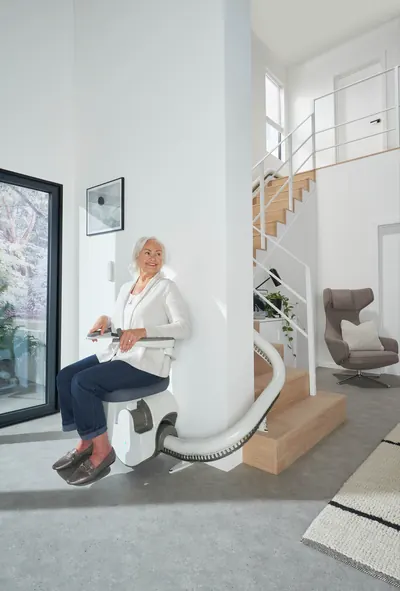
Access Flow X
For staircases down to 24 in and up to 70 degrees.
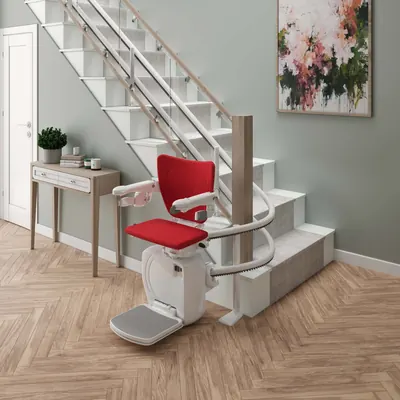
Handicare 4000
The other curved lift. Twin rail, 350 lb option, outdoor version.
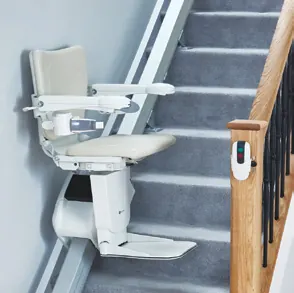
Handicare 1100
Straight stairs, no gear rack at all
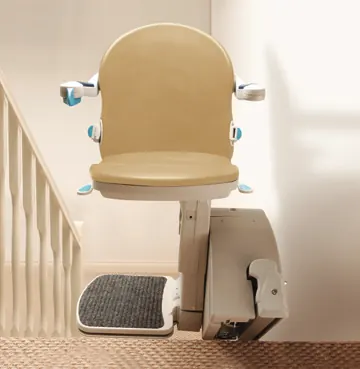
Handicare 1000
Straight stairs, up to 440 lb
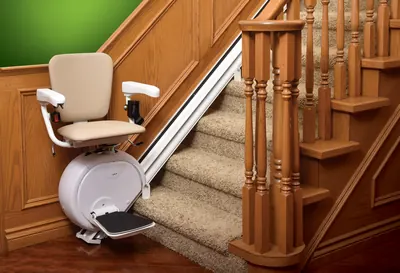
All straight stairlifts
Compare the six models we install
Book a free Freecurve measure
We photo-measure the staircase, show you the lift on your own stairs in 3D, and leave you a written price. No charge for the visit, and no pressure afterwards.